
Introducing the 2026 Cohort of the Siegel PiTech PhD Impact Fellowship
Written by Kate Nicholson, PiTech Initiative Director of Programs and Partnerships
PiTech is pleased to welcome the 2026 cohort of Siegel and Rubinstein PiTech PhD Impact Fellows: 19 Cornell PhD students spending their summer partnering with nonprofits and city agencies across New York City on impactful technical projects.
Now in its sixth year, the Siegel PiTech PhD Impact Fellowship places technical doctoral students in 12-week summer externships with nonprofit and public sector organizations across New York City. Fellows contribute advanced technical expertise to mission-driven projects, while gaining experience applying their skills in public interest settings. We are grateful to the Siegel Family Endowment and Frederic and Susan Rubinstein Impact Fellowship Fund for making this work possible.
What began as a small pilot has grown steadily in both scale and ambition. This year’s cohort includes fellows working with 18 partner organizations on projects related to public health, accessibility, climate, food security, civic technology, public services, and more.
Many of the projects engage directly with the kinds of questions now shaping public interest technology, especially around AI. Fellows are not only building AI tools, but also evaluating their accuracy, auditing for bias, developing accountability frameworks, and exploring what it means for communities to maintain meaningful agency and oversight of these technologies. From benchmarking LLMs for public health information to creating practical AI review guidelines for city agencies, fellows and partner organizations are thinking carefully about what responsible tech adoption looks like in practice.
The projects span a range of applications: AI tools that flag duplicate invoices before payment, digital twin warehouse models that optimize food storage and reduce spoilage, AI agents that bring the voices from history to life in a museum setting; methods for distinguishing locally emitted methane from background atmospheric concentrations; and AR and VR technologies designed to support people living with intellectual and developmental disabilities. Check them all out below!
Congratulations to our 2026 Siegel and Rubinstein PiTech PhD Impact Fellows and partner organizations. We look forward to sharing more about your work at the end of the summer.
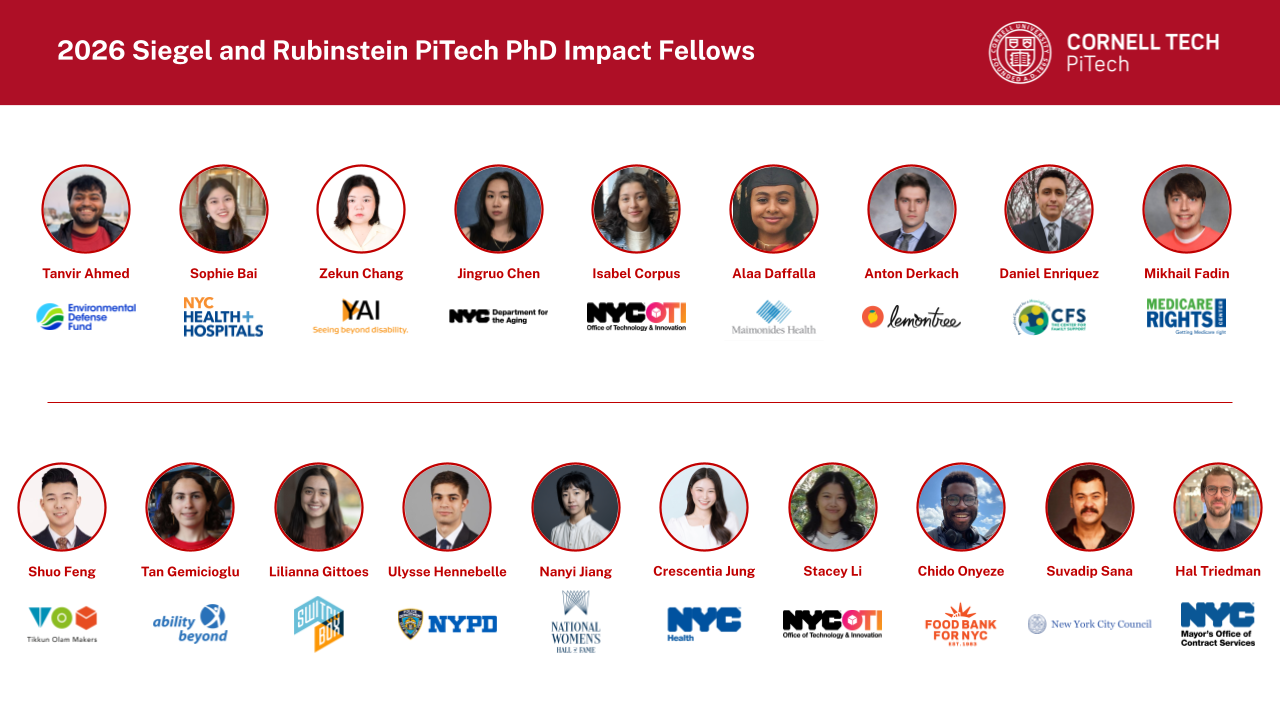
Tanvir Ahmed, Environmental Defense Fund MethaneSAT
Improving the accuracy of MethaneSAT's methane emission measurements by developing methods that better distinguish locally emitted methane from background atmospheric concentrations, producing more reliable data to support global emissions reduction efforts.Sophie Bai, NYC Health + Hospitals (H+H)
Expanding H+H’s program evaluation toolkit with additional statistical methods and developing NLP-based case definitions to extract disability and functional status information from unstructured clinical notes.Zekun Chang, Young Adult Institute (YAI)
Evaluating AI-assisted 3D design tools to understand how well they support occupational therapists without CAD or fabrication backgrounds in creating personalized devices for the people they serve.Jingruo Chen, NYC Department for the Aging (NYC Aging)
Prototyping an AI-powered recipe recommendation and feedback system for NYC Aging's meal programs, using machine learning to analyze successful menu patterns, suggest pairings, and surface trends from program feedback to help older adult centers design more balanced and appealing menus.Isabel Corpus, NYC Office of Technology and Innovation
Supporting NYC's new Office of Algorithmic Accountability in developing practical guidelines for evaluating fairness of algorithmic systems used by city agencies, ensuring they meet legal requirements and can be held accountable to the public.Alaa Daffalla, Maimonides Medical Center
Evaluating Maimonides' ambient AI clinical documentation system to assess its accuracy, effect on clinician workload, and billing outcomes, as it is rolled out across inpatient, outpatient, and emergency department settings.Anton Derkach, Lemontree
Building a computer vision and NLP pipeline that reads photos and paired feedback from Lemontree’s helpline to automatically tag food quantity, quality, and variety, enabling personalized resource recommendations and richer impact reporting for food banks and funders.Daniel Enriquez, Center for Family Support
Exploring how VR and AR technologies can support skill development and independence for residents with intellectual and developmental disabilities.Mikhail Fadin, Medicare Rights Center
Advancing an experimental AI chatbot by strengthening its knowledge base, adding public-facing guardrails, and automating content updates, in order to help Medicare helpline counselors more efficiently answer beneficiary questions.Shuo Feng, Tikkun Olam Makers (TOM)
Building an AI agent to search, categorize, and synthesize existing assistive technology market solutions, helping TOM's maker communities more quickly identify needs and accelerate the development of open-source assistive technology.Tan Gemicioglu, Ability Beyond
Using sensor technology to evaluate how different feedback methods support direct care staff in carrying out health and safety protocols for residents with limited mobility, with the goal of improving care quality and reducing pressure injuries.Lilianna Gittoes, Switchbox
Modeling electrification-friendly electricity rate designs and flexible load technologies, including EVs and thermal storage, to assess their potential to slow peak grid growth, improve affordability, and inform clean energy policy advocacy in Northeastern states.Ulysse Hennebelle, NYC Police Department
Prototyping anomaly detection models on 311 and 911 call data to identify emerging public-safety events more quickly, while investigating how early-warning capabilities can be built with transparency, auditability, and human review at their core.Nanyi Jiang, National Women's Hall of Fame
Prototyping AI-driven interactive agents that bring the stories of National Women's Hall of Fame inductees to life using language drawn from their own writings and speeches, while developing ethical and curatorial frameworks for responsibly representing the voices of historical figures in museum settings.Crescentia Jung, NYC Department of Health and Mental Hygiene (DOHMH)
Benchmarking commercially available LLMs against standardized public health prompts to evaluate their accuracy and reliability as health information tools, helping DOHMH develop guidance on responsible AI use for public-facing health contexts.Stacey Li, NYC Office of Technology and Innovation
Conducting cross-agency stakeholder interviews and data analysis to develop an implementation plan for a proposed citywide network of street-level temperature and humidity sensors designed to strengthen NYC's response to extreme heat in high-vulnerability neighborhoods.Chido Onyeze, Food Bank for New York City
Building a data-informed routing optimization framework that improves delivery efficiency, optimizes miles and labor hours, increases service reliability, and creates a framework for long-term analytical capabilities for Food Bank for NYC logistics operations.Suvadip Sana, New York City Council Data Team
Building an AI routing system and MCP server to power a staff-facing chatbot that directs queries across multiple generative AI applications and external tools, helping NYC Council staff get faster, more accurate answers to complex legislative questions through a single seamless interface.Hal Triedman, Mayor's Office of Contract Services
Building an AI tool to automatically flag duplicate invoices in NYC’s PASSPort procurement system before payments are made, reducing financial risk and manual review burden across city agencies.
The PiTech PhD Impact Fellowship supports Cornell University PhD students in technical fields to participate in 12-week summer externships that advance the missions of nonprofit and public sector organizations across NYC. The program is made possible by generous gifts from the Siegel Family Endowment and Frederic and Susan Rubinstein Impact Fellowship Fund. The PiTech initiative is also supported by the Iscol Family Fund for Public Interest Technology and Jean Parker Hill. Learn more at pi.tech.cornell.edu/pitech-phd-impact-fellowship.