
Building AI Agent for NYC Council workflows
Written by Suvadip Sana

Introduction and Challenges
Artificial intelligence can help governments analyze information, streamline administrative work, and make complex public data more accessible. These opportunities are especially relevant in information-intensive institutions such as the New York City Council , where AI could support council staff.
The New York City Council is the legislative branch of New York City government, with 51 members representing communities across the five boroughs. Council members and their staff work across legislation, budgeting, land use, agency oversight, and constituent issues, creating workflows that depend on navigating large amounts of legislative, legal, and administrative information. This makes the Council a particularly interesting setting for AI: an assistant could help staff retrieve legislation, search legal documents, analyze Council data, perform calculations, and access external information through a single interface. At the same time, deploying AI in this environment presents distinct challenges. Council information can be sensitive, making reliance on proprietary frontier models problematic and motivating the use of locally hosted open-source models, which may have weaker reasoning and tool-use capabilities. The system must also determine which Council tool to use for a given staff query, integrate information returned by different tools, and produce grounded responses while avoiding hallucinations or misleading representations of government information.
These challenges motivated my Siegel PiTech PhD Impact Fellowship project: building a tool-using AI agent designed specifically for NYC Council staff. Through the PiTech Fellowship, I worked with the New York City Council Data Team to explore this challenge by developing an AI agent for Council staff that uses open-source models, connects to internal government tools, and incorporates guardrails designed for responsible use in legislative and administrative workflows.
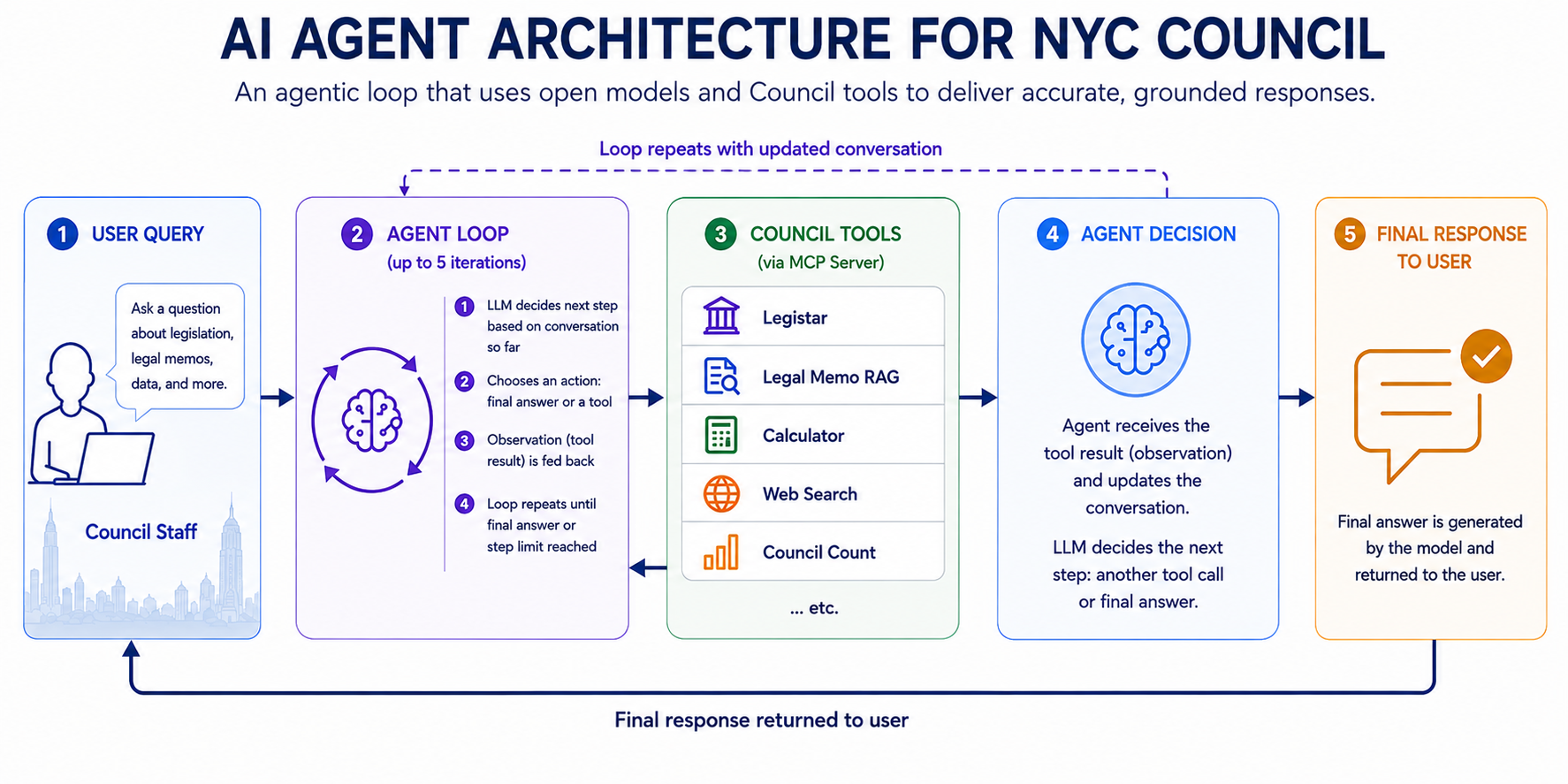
AI Agent Architecture for NYC council: An agentic loop that uses open models and Council tools to deliver accurate, grounded responses.
Project
I designed the system as an end-to-end agentic pipeline that takes a Council staff member’s query, determines which resources are needed, invokes the appropriate tools, and synthesizes the retrieved information into a final response. At the center of the system is an AI Router that interprets each query and decides which tools to use. A Model Context Protocol (MCP) server provides a common interface for connecting the agent to different Council capabilities and data sources. Rather than relying solely on the language model’s internal knowledge, the agent retrieves relevant information through these tools and uses it as context for generating a response. This modular architecture makes it easier to add new Council tools over time.
The system is built around Qwen 3.6-27B as the underlying language model. When a Council staff member submits a natural-language query, the AI Router interprets the request and selects the appropriate tool. TheMCP server connects the agent to several tools, including Legistar for legislative information, a legal-memo RAG system for internal documents, web search for external information, Council Count for Council-related data, and a calculator for computations. The selected tool retrieves or computes the required information, which the model then uses, together with the original query, to generate a context-aware response.

Suvadip Sana
Ph.D. Student, Statistics and Data Science, Cornell University
Impact and Path Forward
The project demonstrates how open-source language models can be transformed from standalone chatbots into practical AI agents capable of supporting complex government workflows. By integrating multiple Council tools through a modular agent architecture, the system can help staff access information and complete routine research tasks more efficiently while keeping sensitive workflows within a more controlled environment. Moving forward, the system can be expanded with additional Council tools, improved routing and tool-use capabilities, and more systematic evaluation of response quality, reliability, safety, and fairness. The longer-term goal is to create a system that can answer questions across a broad range of topics by expanding the tools and specialized agents available through the AI router.