
Algorithmic Support for the Food Bank for NYC’s Delivery Network
Written by Chidozie Onyeze
Introduction
As the largest hunger relief organization in New York City, the Food Bank for NYC serves over 800 community agencies and distributes hundreds of tons of food daily. This immense logistical scale, coupled with truck capacity constraints, requires complex delivery scheduling decisions. The process is further complicated by agency-specific delivery windows and requirements. Currently, expert route planners make these decisions guided by years of domain experience. In my Siegel PiTech PhD Impact Fellowship with Food Bank for NYC, we explore how algorithmic and data-analytic techniques can be integrated into this workflow to augment expert decision-making.
The Process
The project began with a discovery phase to understand the Food Bank's complex operational requirements and routing objectives. Over the course of a month, I met with various members of the transportation logistics team to understand their specific roles within the broader logistics ecosystem. This surfaced crucial aspects of the routing problem that were not initially apparent—for instance, the correlation between driver overtime and traffic incident frequency, and how diverse unloading environments at various agencies create significant disparities in delivery times for similarly sized loads.
I also participated in a ride-along with one of the organization's drivers, gaining firsthand experience of how stops are executed and the real-time considerations drivers face on the ground. This experience was eye-opening, revealing where several of my initial analytical assumptions fell short in practice. Critically, I learned that specialized data sources are necessary to accurately estimate viable truck paths; standard platforms (e.g., Google Maps) often fail to account for commercial vehicle road restrictions.
This discovery process culminated in a comprehensive report documenting the current state of the transportation routing system. By synthesizing institutional knowledge from multiple stakeholders, this document will serve as a valuable ongoing resource for understanding the routing process.
Analysis and Algorithmic Benchmarking
To evaluate current routing outcomes, we analyzed a dataset of orders spanning a six-month period, identifying trends in agency demand and the types of goods ordered. We observed significant heterogeneity in demand across different days of the week, highlighting an opportunity to improve routing efficiency through daily load-balancing.
Using the daily routes selected by expert planners, we evaluated route quality against several key objectives:
Total truck hours
Maximum deployment time of any single truck
Average delivery time to agencies
We then compared these expert outcomes against routes generated by approximation algorithms for variants of the Traveling Salesperson Problem (TSP). The algorithmic approaches consistently improved objective values. While these algorithms cannot currently account for all the nuanced, real-world factors weighed by expert planners, this finding demonstrates a clear opportunity to enhance routing outcomes by combining algorithmic optimization techniques with expert domain knowledge.
As part of this analysis, we also developed custom tools to visualize demand trends and routing outcomes (see Figure 1 for illustrations of the Analysis Tool).
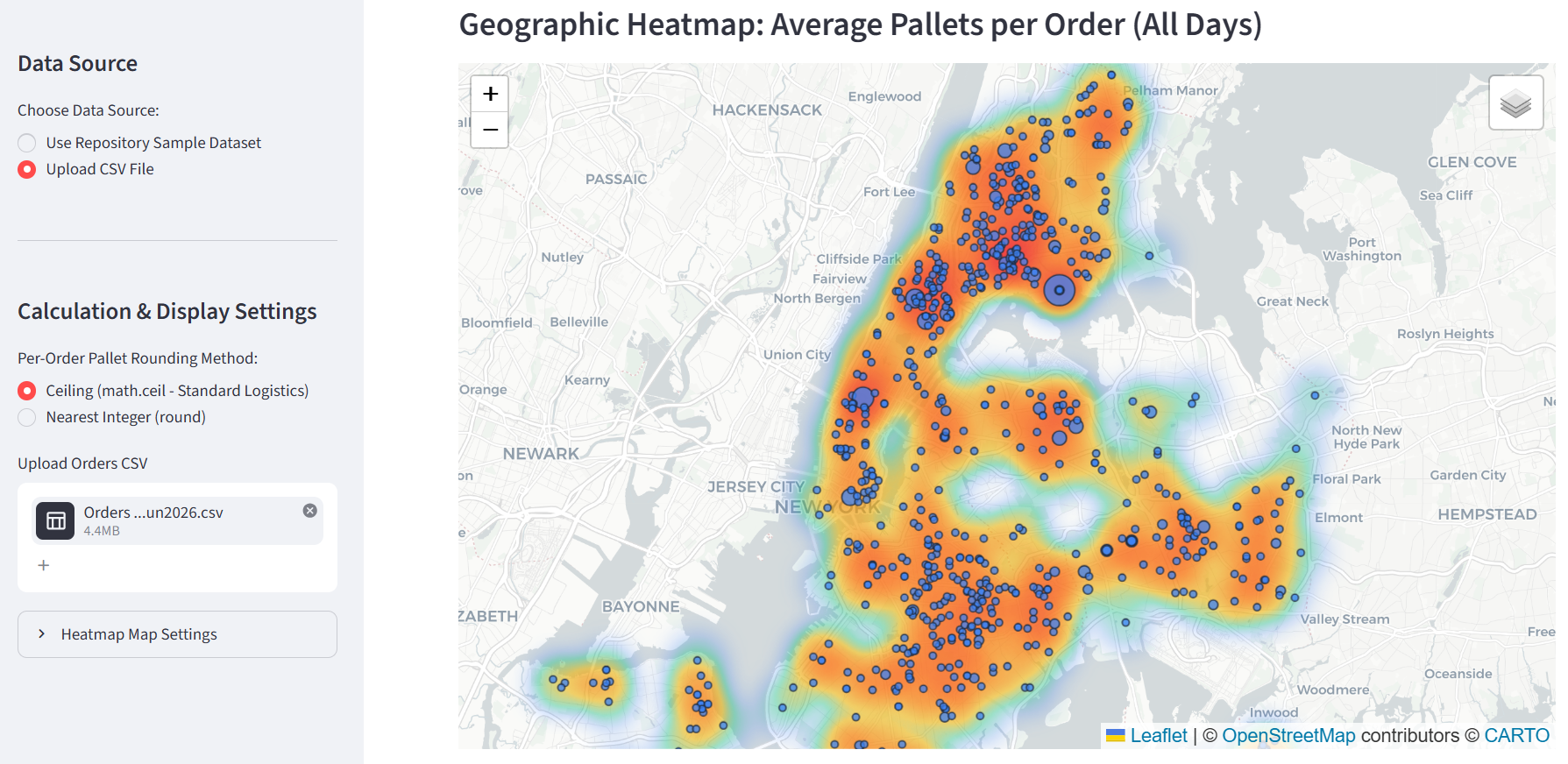
Figure 1: Data Analysis Tool (Heat map)
Algorithmic Routing Suggestion Tool
As a primary deliverable, we developed an interactive tool that applies algorithmic optimization to expert-generated routes, offering suggestions designed to theoretically improve specific operational objectives. A core design principle was to make the tool intuitive and unobtrusive for the expert user. The goal is to highlight efficient alternatives that may have been overlooked, providing both inspiration and theoretical backing for schedule adjustments. By leveraging open-source tools and APIs, we built an interactive GUI that maximizes user control.
We delivered a proof-of-concept to the logistics team, which was then handed over to the Food Bank staff for continued iteration (see Figure 2 for illustrations of the Routing Suggestion Tool).
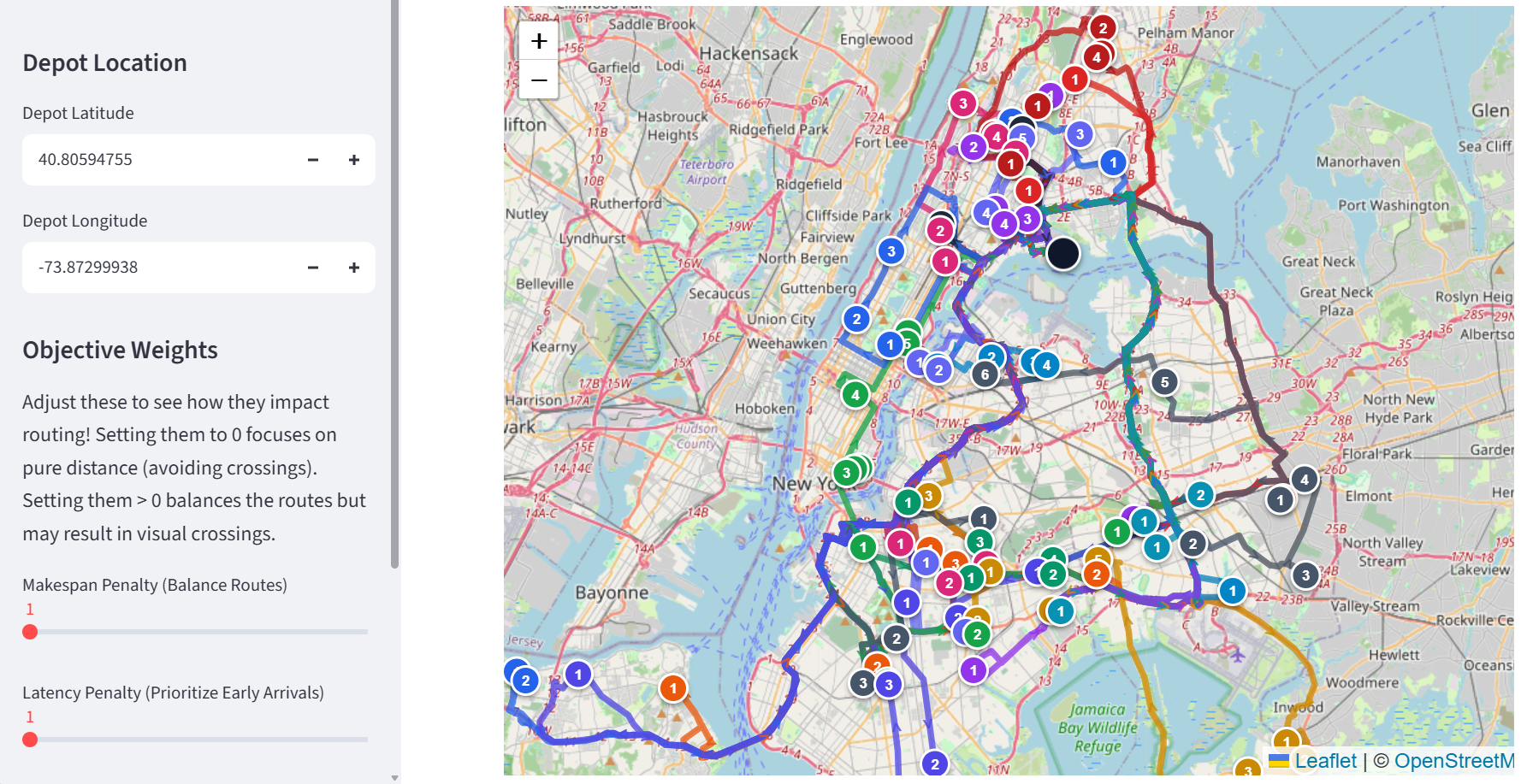
Figure 2: Routing Suggestion Tool
Impact and Future Directions

Chidozie Onyeze
Ph.D. Student, Computer Science, Cornell University
This project delivers impact across three primary areas:
Process Documentation: The state-of-the-system report synthesizes critical operational knowledge into a single, digestible format. This will be highly useful for onboarding new staff and aligning current employees and executive leadership on the mechanics of the transportation system.
Demand Analysis: The newly developed analytical tools enable the team to track demand shifts as operational changes are implemented, providing a systematic way to test and validate hypotheses.
Algorithmic Routing Support: The Algorithmic Routing Suggestion Tool introduces data-driven support to the Food Bank's routing decisions. While real-world constraints will likely reduce the theoretical ceiling, initial evaluations indicate the potential for up to a 30% improvement across combined routing objectives, representing substantial efficiency gains for the organization.